Teaching main idea and supporting details / central idea to 3rd, 4th, and 5th grade students can be a very frustrating experience; it is such a difficult skill to understand. Very few of my lessons seemed to have an effect on my 3rd grade students - either they understood how to find the main idea without my help, or they didn't understand no matter what I did or said.
The curriculum my district used was no help - it introduced central idea by having students read a fictional story from our textbook (about 15 pages long) and fill out the main idea and supporting details in a blank graphic organizer together while we were reading. The students were magically supposed to understand main idea and details after this one activity.
Needless to say, the majority of my students needed a LOT more scaffolding, examples, and strategies in order to have a thorough understanding of main idea.
(Don't have much time? Then go straight to this Main Idea Freebie for 3 main idea activities you can use today.)
Why Most Main Idea Lessons Don't Work
The problem with most main idea resources is that they don't teach students HOW to find the main idea; instead, the resources simply provide students with lots of practice of a skill that they don't really understand. And then students practice finding main idea in the wrong way and form misconceptions that can be very difficult to correct.
Over the years, I experimented with a variety of different ways and strategies to teach main idea and supporting details to my students. I compiled all of the most effective strategies in this Scaffolded Main Idea and Details Resource.
It starts simple and isolates different skills required in order for students to understand main idea. Then, it gets increasingly difficult until students are eventually thinking about the central idea of an entire passage.
This resource minimizes your prep time while maximizing student learning. But if you don't mind a little prep work, then check out the 4 lesson ideas below that will help you teach main idea in a way that struggling students will actually understand.
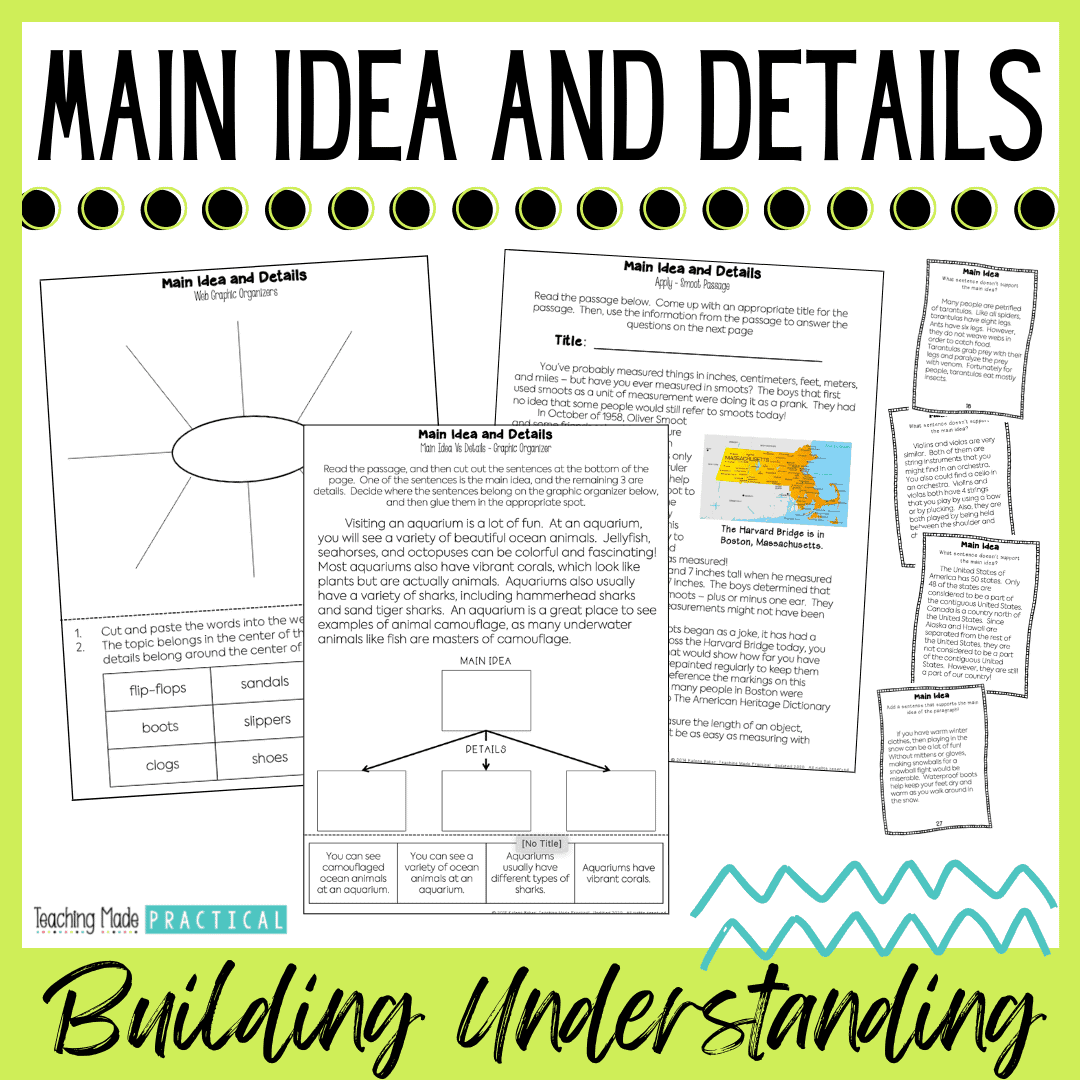
Minimize prep, maximize learning with this Main Idea and Details Scaffolded Resource. The resources start simple and get increasingly more difficult, make it easy for you to differentiate, reteach, or simply introduce main idea to your students.
Best of all, almost all of the resources require absolutely no prep!
A Main Idea / Central Idea Lesson Example Using Titles
Teaching students how to use a title to help them figure out the main idea of a reading passage is an easy and often overlooked strategies.
In nonfiction texts especially, the title will usually tell you exactly what the topic of the passage will be, which is the first step to figuring out the main idea.
Let's say your 3rd, 4th, or 5th grade class is reading Sheila Keenan's Animals in the House: A History of Pets and People. Just based on this title, students should be able to make reasonable predictions as to the main idea and supporting details of the text. You could ask some different questions to help encourage that thinking:
- What will this book be mostly about?
- Do you think one of the supporting details in this book will be about elephants? Why or why not?
- Do you think one of the supporting details in this book will be about dogs? Why or why not?
- What other animals might the author include to support the main idea? How do you know?
- Which of the following statements is more likely to be the main idea of the book: "Dogs make great pets because they are friendly, loving, and loyal," OR "Throughout history, people have depended on a variety of pets for help, companionship, and protection."
Just by thinking carefully about this title, students should be able to predict a reasonable central idea to the book, as well as possible supporting details. In nonfiction books or passages, students can also use headings to make similar predictions of the main idea and details of smaller sections.
You could also cover up the title of a book or passage, and have students make predictions about what the title is after reading. This will get students thinking about what was most important and what the text was mostly about.
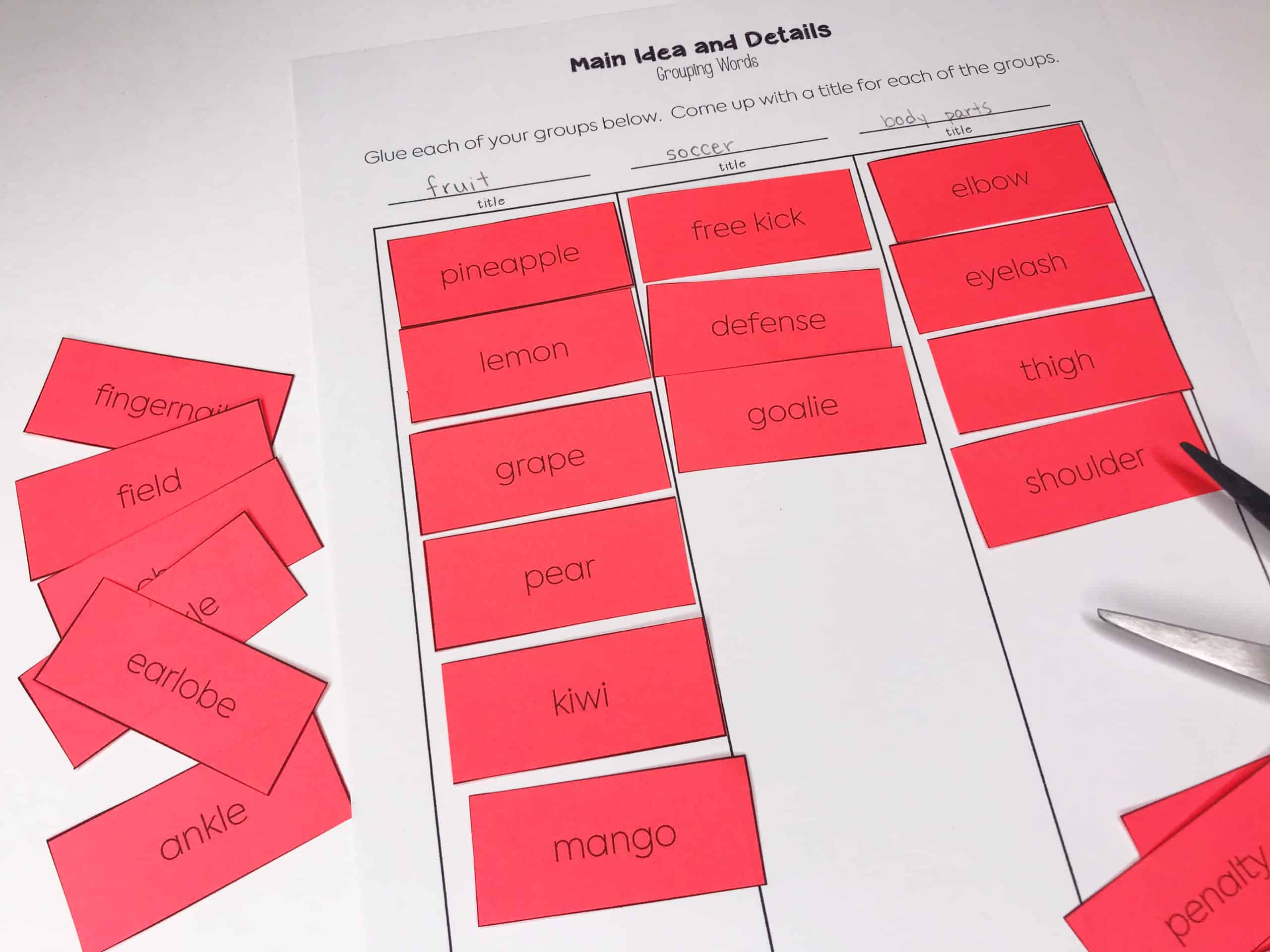
Topic VS Supporting Details Activity - Grouping Words
This is a simple yet powerful activity that can help students distinguish between the topic and supporting details. Simply provide students with a list of words from several categories, have students organize those words into groups, and then have them come up with an appropriate title for each group.
This activity helps address an important struggle students have when it comes to main idea. Students have a hard time understanding that the details that support a certain main idea or topic are all different, yet related to each other. Requiring students to sort words into groups is a great introduction into this concept.
Another important aspect of this activity is having students come up with an appropriate title for each group of words. This is a great way to introduce the concept of topic to your students - which later will help them better understand main idea.
Younger learners, ESOL students, or struggling upper elementary readers could do this same activity using pictures rather than words. They will still get valuable practice with the skill without the frustration of reading words without any context.
Teaching Students That Details Should Support the Main Idea
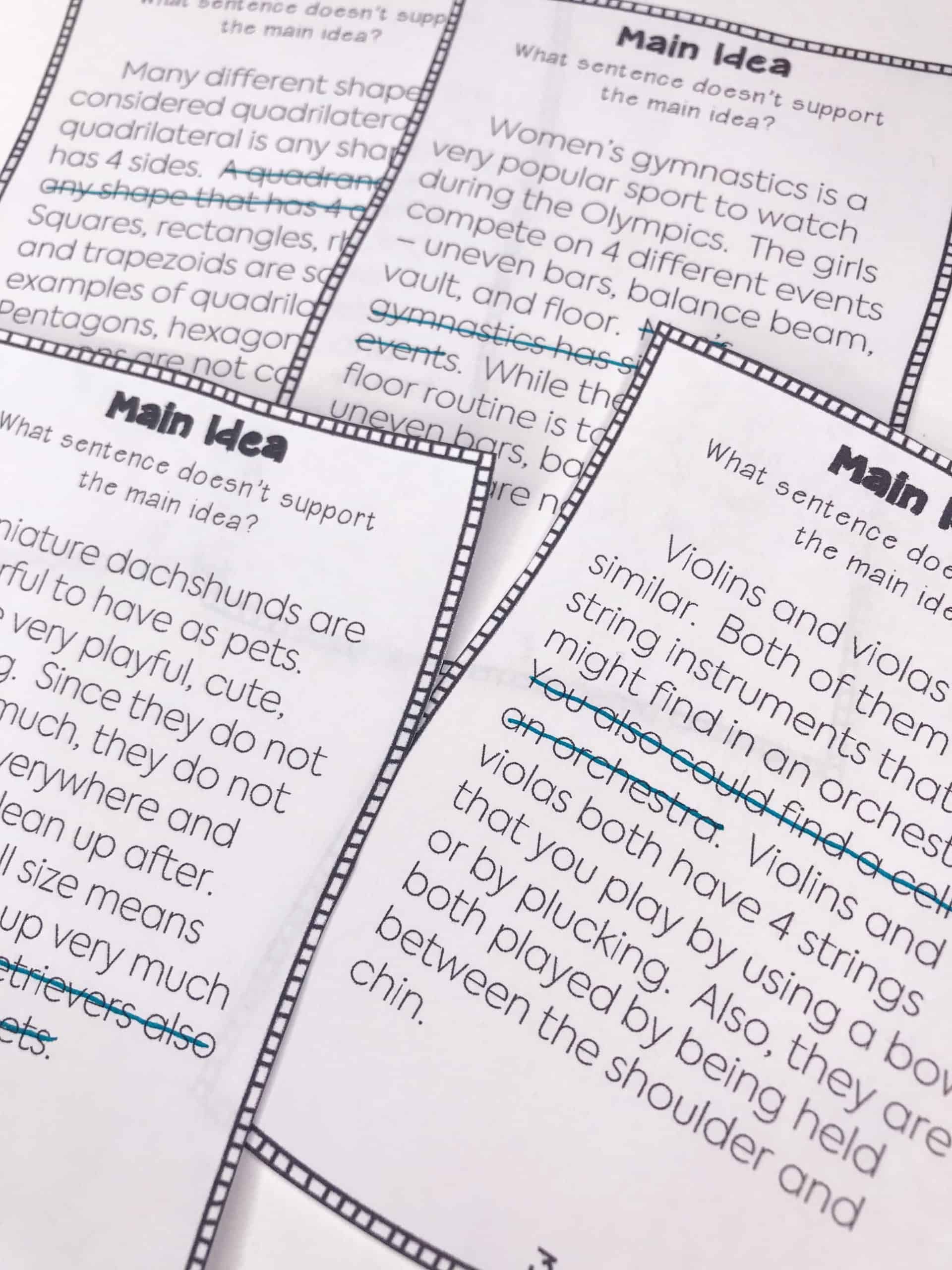
This activity takes a lot more prep if you do it yourself instead of using this Scaffolded Main Idea Resource, but it is a valuable way to assess students' understanding of main idea and supporting details while getting them to think more critically.
Before your main idea lesson, write a paragraph that has a very clear main idea. Then, add a sentence to the paragraph that is somewhat on topic, but doesn't really support the main idea of the paragraph. Students must read the paragraph and determine which sentence doesn't belong.
In order for this activity to be effective, the paragraphs must be written thoughtfully. The sentence that does not belong should not be immediate obvious to students, but instead require students to think carefully about how the details relate to each other to support the central idea.
This is a much better assessment of main idea understanding than the typical "Find the Topic Sentence" activity that many main idea worksheets have.
This activity is also included in this main idea and details free printable!
How to Use Main Idea Graphic Organizers
I've seen a huge variety of cute main idea graphic organizers in my search for main idea resources - umbrellas, flowers, hamburgers, hands, tables, ice cream cones, clouds, popcorn - you name it, it's been done.
But no matter how cute or fun it is, the graphic organizer itself is probably not going to make confused upper elementary students miraculously understand how to find the main idea better.
One of the most frustrating things about typical main idea resources and graphic organizers is that they go straight to having students come up with the main idea of a passage without any scaffolding. This is a HARD skill for students - many adults struggle with this as well!
Instead of expecting students to be able to come up with the main idea statement themselves on a blank graphic organizer, provide students with the main idea and details but DON'T tell them which statements are the details and which statement is the main idea.
Then, have students put the statements in the correct spots on the graphic organizer. This takes away the frustration students feel of trying to come up with the main idea from thin air, while at the same time giving students valuable practice in distinguishing between the main idea and supporting details. (Get a free example of this main idea activity here.)
The more students do this type of activity, the more capable they will be able to find the main idea and supporting details themselves.
According to the feedback I have gotten from my Scaffolded Main Idea Resource, these scaffolded graphic organizers are one of the most helpful resources for teaching main idea.
This scaffolded main idea resource is my best seller for a reason. It is almost completely no prep while drastically improving students' understanding of main idea.
The resource has cut and paste activities, worksheets, task cards, graphic organizers, reading passages, and more that will help your students understand the differences between topic, supporting details, and main idea.
You might also like these other main idea tips, activity ideas, and freebies!
Want These Free, No Prep Main Idea Activities?
Comments 17
Pingback: Teaching Main Idea & Details | Tips & Materials | Christin Sanders
Pingback: Teaching Main Idea and Details | ceiliúradh
Pingback: Teaching Main Idea & Details | Tips & Materials | A Happy Learner
Can you share your ideas with me to help me DI for my inclusion students?
Author
I think inclusion students often are most successful when they are provided good scaffolding. I’ve shared some of my ideas for scaffolding a few different skills here. . I hope you find something helpful.
Thank you so much for the ideas. I am always looking for new ideas to implement in my classroom. My K students have to give main ideas to be at the reading level the district would like by the end of kindergarten. This is a very difficult concept for 5 and 6 year old’s to understand. It has no place for assessment in Kindergarten. Thank you for sharing.
Author
I agree, that does not seem like an age appropriate expectation!
I really enjoyed the flow of these concepts and how they were each carefully thought out. They rocked!
Ideas provide scaffolding
Your ideas for teaching main ideas are awesome. I’m truly relieved from stress of looking for how to do it. God bless you.
Author
So happy to be able to help!
Thank you very much! These activities are easy to teach for teachers as well as easy to understand for students to learn about main idea and details. I love it!
This is awesome.. I will definitely use your ideas. The strategies really make sense and will minimize stress of the students
I love your main idea and details lessons!
Author
Thank you!
It’s an excellent website of resourceful information
Author
Thank you so much!